
Many committees default to whatever catalog showed up in their inbox last year, or they burn out their volunteers planning an elaborate carnival nobody has the bandwidth to pull off. Neither approach sets your group up for a stress-free campaign.
This guide breaks down the main types of PTA/PTO fundraisers, walks through how to pick the right one for your school's size and volunteer capacity, and flags the mistakes that quietly sink otherwise good campaigns.
Key Takeaways
- PTA/PTO fundraising covers costs that school budgets miss, like supplies and teacher gifts
- Fundraisers fall into three types: product sales, event/pledge campaigns, and digital tools
- The right fundraiser fits your volunteers' bandwidth and timeline, not trends
- Low-minimum product fundraisers deliver strong profit with minimal logistics
- Parent feedback and realistic commitments sustain long-term participation
What Is PTA/PTO Fundraising and Why It Matters
PTA/PTO fundraising refers to the organized efforts of parent-teacher groups to raise money for needs the school's official budget doesn't cover. It's supplemental income, not a replacement for public school funding.
PTA vs. PTO: The two aren't interchangeable. A PTA is a local chapter affiliated with the National PTA, so members pay dues split across local, state, and national levels. A PTO operates independently, without ties to National PTA or its dues, giving it more flexibility in structuring fundraising and spending.
Why Schools Rely on PTA/PTO Fundraising
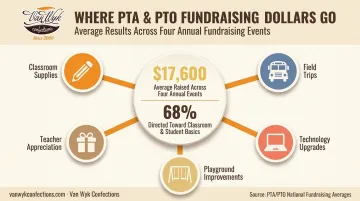
These funds typically go toward:
- Classroom supplies and teaching materials
- Field trips and transportation
- Technology upgrades
- Teacher appreciation events
- Playground and facility improvements
A national parent poll found that schools running fundraisers raised an average of $17,600 across four fundraising events. 68% of parents said the proceeds went toward basics like textbooks and classroom equipment, not extras.
This is historical data reported by Education Week from a 2004 study, so today's numbers will vary by school. Still, it makes a clear point: fundraising often covers necessities, not luxuries.
Without steady fundraising, schools face real consequences. Enrichment programs get cut. Equipment purchases get delayed a semester or two. Teachers often end up covering classroom supply costs themselves.
Types of PTA/PTO Fundraising Ideas
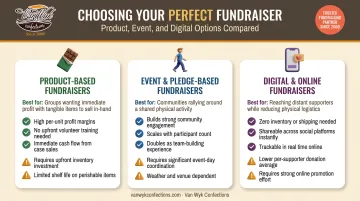
Most fundraisers fall into three broad categories. Each suits a different school size, timeline, and volunteer capacity. The most successful PTAs rarely rely on just one type. They layer two or three across the school year to keep things fresh and spread out the workload.
Product-Based Fundraisers
Product-based fundraisers involve selling tangible items, such as candy, chocolate bars, spirit wear, popcorn, or cookie dough, through order forms that students bring home to family, friends, and neighbors.
Best suited for: Schools wanting predictable, repeatable revenue, especially for a fall kickoff or holiday campaign.
Key strengths:
- Easy participation for students of any age, from kindergarten through middle school
- Low day-to-day volunteer coordination once product ships
- Structured order forms that make planning straightforward
The main limitation is upfront logistics. Someone needs to manage order collection and coordinate a distribution day, and if a supplier requires a high minimum order, that can strain a smaller PTA's cash flow before a single item sells.
This is where the supplier you choose matters. Van Wyk Confections, a family-owned fundraising supplier based in Castle Rock, Colorado, runs its product programs around a single-case minimum instead of the bulk minimums many competitors require. Their core lineup includes:
- The Original ONE DOLLAR BAR
- Chocolatiers Premium Chocolate Bars
- Famous Fortune Cookies
- Sweet & Salty Pretzel Rods
Their chocolate bar line is peanut-free and gluten-free, which matters for schools navigating allergy policies. With warehouses positioned across the country, orders ship fast without your committee needing to manage inventory for weeks.
For a first-time PTA or a smaller school without a huge volunteer roster, a low-minimum program like this removes a lot of the financial risk that usually comes with product sales.
Event & Pledge-Based Fundraisers
Event and pledge-based fundraisers build a single activity, a walk-a-thon, read-a-thon, carnival, auction, or bake sale, around collecting pledges or charging for attendance.
Best suited for: Schools with an engaged volunteer base looking to build school spirit alongside fundraising dollars.
The profit-to-cost ratio here can be excellent, particularly for pledge "thons" with little to no product cost involved. One PTA's 2024–2025 financial disclosure reported $64,240 in walkathon income against $6,672 in expenses, a net proceeds-to-expense ratio of roughly 8.6 to 1, based on that school's own reported figures.
That's one school's result, not a national average, but it shows how lean a well-run event can be.
The trade-off is lead time and staffing. These events typically require:
- Weeks of planning for logistics and volunteer scheduling
- A larger volunteer team than a product sale
- A weather-proof or venue backup plan
Digital & Online Fundraisers
Digital fundraisers, crowdfunding pages, peer-to-peer campaigns, text-to-give, QR codes, and social media donation drives, work well for reaching people a paper form never will.
Best suited for: Busy families, grandparents across the country, alumni, or any school wanting a fast, low-effort campaign layered on top of another fundraiser.
Strengths include:
- Zero inventory or delivery logistics to manage
- Easy sharing across social networks and email lists
- Fast setup compared to event planning
The catch is donor fatigue. Run these too often, or without a clear goal attached, and engagement drops fast, so treat digital campaigns as an addition, not the sole strategy.
How to Choose the Right Fundraiser for Your PTA/PTO
The right fundraiser depends on your school's specific situation, not what the school down the road is doing this year.
Factors to Consider
- Purpose and goal: Is this a large one-time need, like new playground equipment, or an ongoing operational cost like classroom supplies?
- Volunteer bandwidth: Be honest about how many hours your core team can commit each week. Most PTAs today run leaner than they did a decade ago, with fewer groups fielding large volunteer benches.
- School size and family engagement: Larger schools can often support big events; smaller schools frequently see better returns from simple, high-margin options.
- Upfront cost and minimums: Check whether a product fundraiser requires a large minimum order or offers low-minimum entry, like a single case.
- Family preferences: A short survey can tell you whether parents lean toward product sales, direct donations, or event participation before you commit.
- Seasonal timing: Product sales tend to perform well in the fall; online giving often does better around the holidays.
There's no universal formula for matching school size to fundraiser type. The Association of Fundraising Distributors and Suppliers recommends comparing real dollar results from groups of similar size and scope rather than choosing based on an advertised profit percentage alone.
Mistakes to Avoid When Planning Your Fundraiser
Even well-intentioned PTAs trip over the same handful of mistakes year after year.
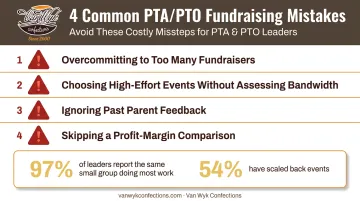
- Overcommitting to too many fundraisers. Packing the calendar causes volunteer burnout and donor fatigue. A recent PTO Today survey found 97% of leaders say the same small group does most of the work, and 54% have scaled back events due to low turnout.
- Choosing a high-effort event without honestly assessing bandwidth. A carnival sounds exciting in an August planning meeting, less so in October when only three volunteers show up to set up tables.
- Ignoring past parent feedback. If last year's catalog sale drew complaints about overpriced items, running it again erodes trust and tanks participation.
- Skipping a profit-margin comparison. Comparing minimums, delivery timelines, and margins before committing often reveals more profit potential. A low-minimum fundraiser can outperform a bigger program with less effort.
Conclusion
PTA and PTO fundraising keeps school programs running past what the standard budget allows. Product, event, and digital fundraisers each serve a different need, and combining them thoughtfully across the year raises more money while keeping your community engaged rather than exhausted.
For product-based campaigns specifically, partner with a supplier offering a low case minimum and fast nationwide shipping. A program built for first-time organizers, like Van Wyk Confections, can help your PTA raise meaningful funds without burning out the same five volunteers who always show up.
Frequently Asked Questions
What PTA fundraiser ideas bring in the most money?
Pledge-based events like walk-a-thons and read-a-thons often perform well since they carry little to no product cost. High-margin product fundraisers with low minimums are also strong earners. Low overhead is the common thread behind the top performers.
What are some fun PTA fundraiser ideas?
Fall festivals, dance-a-thons, trivia nights, and costume contests are popular picks that build school spirit while bringing in funds. These work especially well when paired with a simple product sale earlier in the year.
What should PTA money be spent on?
Common uses include classroom supplies, field trips, technology upgrades, teacher appreciation, and playground or facility improvements. Many groups also fund family events and student enrichment programs.
What is the difference between a PTA and a PTO?
A PTA is affiliated with the National PTA and its members pay dues covering local, state, and national portions. A PTO is independent, isn't tied to a national association, and has more flexibility in its fundraising and spending structure.
How do I choose between product sales and online donations for my PTA?
Base the decision on volunteer time available, what your families have told you they prefer, and the profit margin you need to hit your goal. A quick parent survey can settle this faster than guessing.
Are there low-cost or no-upfront-cost PTA fundraiser options?
Yes. Shoe drives, direct donation campaigns, and low-minimum product fundraisers all require little to no upfront investment. These are solid choices for smaller PTAs or groups just getting started.