Here's the answer: tuition rarely covers everything. Most independent schools rely on tuition for nearly 80% of operating revenue, according to the National Business Officers Association, leaving a real gap that fundraising has to close.
This guide breaks down product sales, events, digital campaigns, and the rules that keep volunteers from burning out while raising real money.
Key Takeaways
- Tuition covers most, but not all, of a private school's operating budget
- Product fundraisers with high margins reduce volunteer hours and burnout
- The 3:1 rule gives a quick gut-check for any fundraiser idea
- Diversifying across product sales, events, and digital campaigns beats relying on one big event
Why Private Schools Still Need to Fundraise Beyond Tuition
Tuition checks feel like they should cover everything, but they rarely do. The gap between what families pay and what it costs to run a school gets filled through annual giving, grants, and fundraising campaigns.
There's also a tax angle worth understanding. Tuition payments are not tax-deductible, but charitable gifts to a nonprofit school typically are. That distinction matters for families deciding how to give.
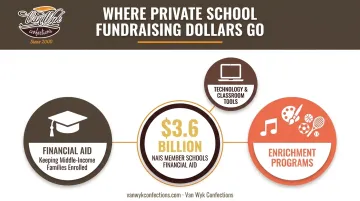
Where fundraising dollars usually go:
- Financial aid that keeps middle-income families from being priced out
- Technology upgrades and classroom tools tuition budgets don't stretch to cover
- Enrichment programs like art, music, and athletics that differentiate the school
NAIS member schools awarded nearly $3.6 billion in need-based financial aid during the 2024-2025 school year, according to NAIS. That money largely comes from fundraising and endowment income, not tuition dollars.
Schools with strong financial aid programs depend on this giving so tuition doesn't have to climb to a level that shuts out the families who make campus communities genuinely diverse. Skip the fundraising, and either aid budgets shrink or tuition rises. Neither outcome helps enrollment.
Most Profitable Product-Based Fundraising Ideas for Private Schools
Product fundraisers remain one of the highest-margin, lowest-effort categories available to schools. There's no venue to book, no auction to plan, and minimal volunteer coordination beyond distributing order forms and collecting cash or, increasingly, online payments.
Chocolate and Candy Bar Fundraisers
Premium chocolate bars have stayed a private-school staple for good reason. They're shelf-stable, easy for kids to sell door-to-door or at pickup, and they typically return more per unit than lower-margin items like wrapping paper.
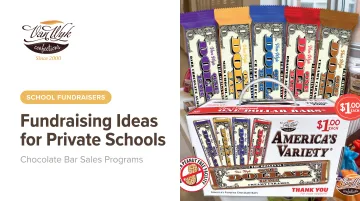
Suppliers like Van Wyk Confections offer factory-sealed bars, including the Original ONE DOLLAR BAR and the Chocolatiers Premium line, built specifically for fundraising groups. Key features that matter to school coordinators:
- 1-case minimum order — no need to commit to pallets of product upfront
- Peanut-free options available for schools managing strict allergy policies
- Factory-sealed freshness: every case ships sealed, so quality isn't left to chance
That low order minimum matters more than it sounds. Schools that guess wrong on participation with a high-minimum vendor end up with unsold inventory eating into profit. A one-case entry point keeps that risk small.
Gourmet Popcorn Sales
Flavored popcorn checks boxes that a lot of fundraising products miss. It has a long shelf life, so there's no scramble to sell everything before it spoils. It also appeals across age groups, meaning grandparents and coworkers buy just as readily as classmates do.
Pre-sale logistics are simple too: order forms go out, sales close on a set date, and one delivery day handles distribution. No freezers, no melting, no last-minute panic.
Pretzel Rods, Twists, and Fortune Cookies
Cookie dough and wrapping paper have been the default for decades, which is exactly why a sweet-and-salty pretzel rod stands out. It's a different taste profile than most competing fundraisers, and unlike frozen cookie dough, there's no cold-chain logistics or spoilage risk to manage. Van Wyk Confections introduced the pretzel rod format in 2012 and added a twisted version in 2017, giving coordinators two shelf-stable options at the same price point.
Fortune cookies bring the same low-hassle profile with added novelty. A themed batch does double duty as a fundraiser item and a fun giveaway during spirit week or a school carnival. That crossover appeal tends to get students more excited to sell, since they're promoting something genuinely fun rather than just another catalog item.
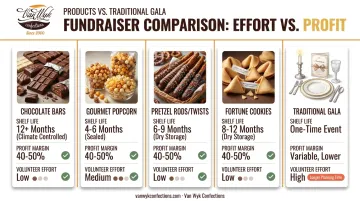
Why product fundraisers win on margin: A well-run product sale can return 40-50% profit with a few hours of volunteer coordination. Compare that to a gala, which might net a similar percentage but demands months of committee meetings, vendor contracts, and a venue deposit. For schools without deep volunteer benches, that time difference is the whole ballgame.
Creative Event and Activity-Based Fundraising Ideas
Events build school spirit in a way product sales can't. They also tend to require more planning, so it helps to know which ones fit a smaller volunteer team and which ones need serious lead time.
Low-Effort Events With High Participation
These formats need minimal setup but still generate strong buy-in from families:
- Spirit Days and Dress-Up Days: Students pay $1 to $5 to wear pajamas, costumes, or crazy socks for the day, with near-zero planning and high turnout.
- Walk-a-thons, Fun Runs, and Read-a-thons: Pledge-per-lap or pledge-per-page models carry no upfront product cost and double as a wellness or literacy push.
- Family Trivia Night or Game Night: Ticket sales plus concessions add up fast, with none of a gala's planning overhead.
- Carnivals and Field Days: Game booths, concession stands, and activity tickets appeal directly to younger kids, driving strong turnout at K-8 schools especially.
School Auctions and Galas: A Long-Term Investment
For schools ready to invest more time, auctions and galas sit at the other end of the spectrum. Auctions can produce the biggest per-event totals, but they need an established donor base and months of committee work. The payoff can be dramatic: Saddle River Day School grew its annual gala from roughly $30,000-$40,000 to more than $500,000 a year, according to a NAIS report on building a culture of giving. That growth took years of relationship-building, not one good event night.
For a school just getting started, a gala is a long-term investment, not a quick win.
Digital and Online Fundraising Options
Online tools cut down on paperwork, cash handling, and the pledges that quietly get forgotten. For busy private-school families already stretched thin, that reduction in friction matters.
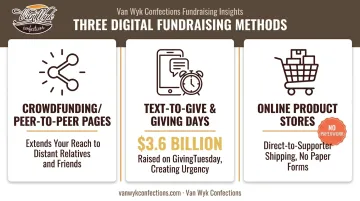
Crowdfunding and peer-to-peer campaigns. Personalized student fundraising pages let grandparents, family friends, and out-of-town relatives give directly online. That extends reach well past the families who show up to pickup every day.
Text-to-give and one-day giving challenges. A 24-hour giving day, pushed through text and social media, creates urgency that a month-long campaign never manages. GivingTuesday alone generated $3.6 billion in US donations in a single day in 2024, per GivingTuesday — proof that a compressed timeline can drive real participation when the messaging is clear.
Online product stores. Many product fundraiser suppliers, including Van Wyk Confections, now offer online ordering with direct-to-supporter shipping. Orders get placed and paid for online, then shipped straight to the buyer's door. That eliminates:
- Paper order forms that get lost in backpacks
- Cash collection and the accounting headache that comes with it
- Manual sorting and delivery of bulk product at school
Schools don't have to pick one or the other, either. Running a brochure sale alongside an online store covers supporters who prefer either method.
Tips to Maximize Fundraising Success (and Avoid Volunteer Burnout)
Not every fundraiser is worth running. Before committing volunteer hours, it helps to run the numbers.
The 3:1 rule. A fundraiser's net proceeds should land at roughly three times its total cost, including product cost, prizes, and staff time, to be considered worthwhile. It's a widely used benchmark for a quick gut-check, not a hard scientific standard, but it works as a filter for separating strong ideas from time-wasters.
A few other practices that keep programs sustainable:
- Limit major fundraisers to 1-2 per year. Supplement with smaller, ongoing campaigns rather than constantly asking the same tuition-paying families for more.
- Choose low-risk products. Look for minimal upfront cost and no high order minimums. Van Wyk's 1-case minimum, for instance, means a school won't get stuck with unsold inventory if turnout runs lower than hoped.
- Set a specific dollar goal and say what it's for. "$5,000 for new library books" raises more than a vague ask, because donors respond to transparency about where their money lands.
Skip these steps, and even a good fundraiser idea can leave volunteers exhausted and families annoyed by a fourth ask in one semester.
Frequently Asked Questions
What is the most profitable fundraiser for private schools?
Product-based fundraisers like chocolate, popcorn, and pretzels tend to be most profitable, often returning 40-50% margins. They require little overhead, no venue costs, and far fewer volunteer hours than events.
What is the 3 to 1 rule for fundraising?
It's a benchmark suggesting a fundraiser should net at least three dollars for every dollar spent running it. Schools use it as a fast way to decide if an idea is worth the effort before committing volunteers.
How much money do private schools typically need to raise beyond tuition?
Tuition covers roughly 80% of a typical operating budget, leaving the remainder to fundraising and gifts. That gap usually funds financial aid, facilities upkeep, and enrichment programs tuition alone doesn't stretch to cover.
What is the best fundraiser for a small private school with limited volunteers?
Product fundraisers or pledge-based events like read-a-thons work well since they require little event planning or on-site staffing. Both can run with a handful of parent volunteers coordinating logistics.
How many fundraisers should a private school run each year?
One or two major campaigns paired with a few smaller, low-effort fundraisers spread across the school year tends to work best. This spacing prevents the donor and volunteer fatigue that comes from constant asks.
Are product fundraisers profitable for private schools?
Yes. Products with high per-unit margins and low order minimums deliver steady profits regardless of school size. Van Wyk Confections' chocolate bars and pretzel rods carry no risk of unsold inventory since they ship pre-packaged for direct sale.