
That's money families are already planning to spend. The question is whether it flows to a big-box candy aisle or into your school, team, or church's fundraising account.
Schools, sports teams, churches, and nonprofits all need fast, dependable ways to raise money. A well-run Halloween candy fundraiser turns a purchase families are making anyway into profit for your cause instead.
This guide covers realistic profit numbers, which candy actually sells, creative selling tactics, and a step-by-step plan for running a campaign that finishes strong before October 31.
Key Takeaways
- Well-run candy fundraisers typically return 40-50% profit on sales, depending on the supplier and product mix.
- Pair top-selling chocolate with allergy-friendly options to widen your buyer base.
- A 1-case minimum order lets small groups start selling without financial risk.
- Early planning matters: nearly half of Halloween shoppers start buying in September.
Why Halloween Is the Perfect Season for a Candy Fundraiser
In October, people are already primed to buy candy. That makes selling far easier than pitching an unrelated product in the middle of winter.
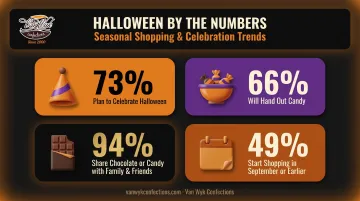
The National Retail Federation (NRF) found that 73% of consumers planned to celebrate Halloween in 2025, and 66% planned to hand out candy. Nearly all of them, 94% according to the National Confectioners Association, intended to share chocolate or candy with friends and family. That's about as strong a built-in market as any fundraiser will find.
Timing works in your favor, too. NRF reported that 49% of Halloween shoppers began buying in September or earlier in 2025. That means:
- Campaigns that wait until mid-October already miss part of the audience
- Groups that start in September or early October reach buyers before Halloween budgets are spent
- Early sellers get first access to offices, neighbors, and family networks stocking up for the season
Halloween fundraisers also piggyback naturally on events families already attend. Trunk-or-treats, school festivals, and church gatherings give you a built-in crowd instead of having to create one.
Unlike a year-round popcorn or gift-wrap campaign, Halloween candy comes with a hard deadline. Once October 31 passes, urgency disappears. That deadline pressure speeds up sales: buyers know the window is closing, and sellers have a clear finish line.
How Much Profit Can a Halloween Candy Fundraiser Really Make?
The math behind a candy fundraiser is simple: a group buys candy at a wholesale price per case, resells each piece at a set retail price, and keeps the difference.
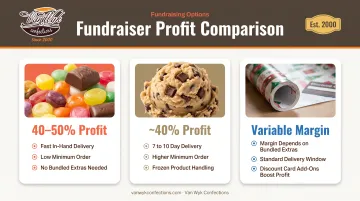
Van Wyk Confections' fundraising model, for example, targets 40-50% profit for the organization, with the exact percentage depending on quantity ordered, number of sellers, and shipping method. That range is a solid benchmark for a well-structured program.
An Illustrative Profit Example
To see how this plays out, consider a hypothetical case of 240 individually wrapped bars selling at $1.00 each. These numbers are illustrative only, not a specific quote:
| Line item | Illustrative figure |
|---|---|
| Units per case | 240 |
| Retail price per unit | $1.00 |
| Total potential revenue per case | $240.00 |
| Group profit at 45% | $108.00 |
| Approximate wholesale cost per case | $132.00 |
Sell 10 cases at that rate and a group nets roughly $1,080, assuming every bar moves. The math scales directly with participation, which is why recruiting enough sellers matters as much as picking the right product.
How Candy Compares to Other Fundraisers
Not every popular fundraiser type performs the same way. Cookie-dough programs commonly advertise profit margins around 40%, though delivery windows can run 7-10 business days and shipping costs often apply below a minimum order size.
Wrapping paper and discount-card programs vary more widely. Margin depends on what's bundled in—prizes, packing, custom branding—and a lower headline percentage sometimes includes more support than a higher one.
The Association of Fundraising Distributors and Suppliers (AFRDS) notes that percentage alone doesn't equal profit. Two programs offering "50% vs. 40%" might net the same real dollars once freight, prizes, and packing costs are factored in.
Order Size and Risk
Bulk purchasing generally improves margin, but overordering is a real risk if a group doesn't have enough sellers. That's where low minimums help:
- A 1-case minimum order lets a small group test the waters without committing to hundreds of units upfront.
- Groups can reorder as inventory sells instead of guessing at total demand from day one.
- No upfront fees or consignment terms: you pay for what you order, and everything sold above cost is fundraising revenue.
What Candy Sells Best for a Halloween Fundraiser?
Not all candy sells equally well as a fundraising product. The best performers share a few traits:
- Recognizable branding buyers trust without needing an explanation
- $1-$2 price points that feel like an easy "yes" rather than a big ask
- Individually wrapped pieces for hygiene and simple distribution
- Self-serve packaging that doesn't require sellers to divide anything up
Chocolate Leads, But Variety Matters
Chocolate remains the top Halloween treat category. According to a Circana 2025 Halloween trends report, chocolate was selected by 75% of treat-giving households. Gummy, chewy, and sour candy followed at 59%, with hard candy at 36%.
Households often pick more than one category, so a mixed lineup tends to outsell a single-product campaign.
Allergy-Friendly Options Widen Your Market
Food allergens influenced Halloween plans in roughly one-third of U.S. households, per Circana's data. A clearly labeled peanut-free option reaches families and classrooms that would otherwise sit out entirely.
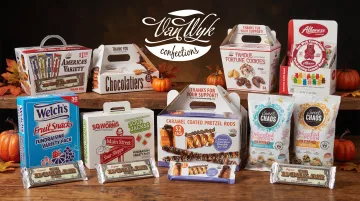
Van Wyk Confections' lineup illustrates what this looks like in practice:
- The Original ONE DOLLAR BAR: 240 bars per case, individually sealed, made in a peanut-free facility, at $1.00 each
- Chocolatiers Premium Chocolate Bars: 200 bars per case at $2.00 each, produced in a dedicated peanut-free and gluten-free facility with kosher certification
Both ship factory-sealed and guaranteed fresh on arrival, which matters when a case sits in a garage for three weeks before Halloween night.
Rounding Out the Lineup
Not every buyer wants chocolate. Pairing chocolate bars with non-chocolate items broadens your reach:
- Sweet & salty pretzel rods (peanut-free, $1 each)
- Gummy bears and sour worms (gluten-free, fat-free)
- Fortune cookies and fruit snacks for buyers avoiding chocolate altogether
When choosing a supplier, look for nationwide distribution, a low order minimum, and fast delivery. A supplier shipping from a single regional warehouse can leave you waiting past Halloween — a risk not worth taking with a hard deadline already in place.
Creative Halloween Fundraising Ideas to Boost Sales
Selling candy doesn't have to mean cold knocking on doors. A few tactics can expand your reach:
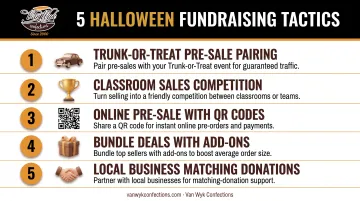
- Pair pre-sold candy with a Trunk-or-Treat event. Families attending a community gathering they'd go to anyway can buy product on the spot, no separate sales pitch required.
- Run a classroom or team sales competition. A small prize for the top-selling group creates friendly pressure that lifts per-participant sales.
- Offer online pre-sale ordering with QR codes. Supporters outside the neighborhood, like out-of-town grandparents, can order and pay without ever seeing a paper form.
- Build bundle deals. Adding a Halloween sticker sheet or glow bracelet to a candy bundle raises the average order value without much added cost.
- Partner with a local business for a matching-donation promotion. A sponsor agreeing to match sales up to a set amount can multiply the impact of the same selling effort.
None of these guarantee a specific lift in revenue, but each gives sellers a stronger reason to ask and buyers a stronger reason to say yes.
How to Run a Profitable Halloween Candy Fundraiser: Step-by-Step
Running the sale well matters as much as picking the right candy. Follow this sequence to keep inventory moving and profits on track.
Plan Your Timeline
Start placing orders 3-4 weeks before Halloween. That buffer covers shipping time and still leaves sellers a solid 2-week window to move product before the deadline hits. Waiting until mid-October compresses everything and risks product arriving after families have already stocked up elsewhere.
Manage Distribution and Inventory
Case-based ordering keeps distribution simple:
- Hand out full or partial cases to sellers instead of splitting loose candy
- Reorder as cases sell out so leftover inventory isn't sitting in a closet come November
Track Sales and Collect Payments
Use a basic spreadsheet or fundraising app to log:
- Units distributed per seller
- Units sold and money collected
- Remaining inventory by case
Checking this weekly, not just at the finish line, makes it easy to catch a slow seller early and redistribute stock before it's too late.
Common Mistakes That Cut Into Your Profit
Even a solid candy fundraiser can underperform if a few avoidable errors creep in.
- Overordering or underordering without a baseline. Base orders on group size and past sales history when you have it, not optimism alone.
- Choosing overpriced or low-margin products. If the asking price feels steep to buyers, sales stall no matter how good the candy tastes.
- Starting marketing too late. Nearly half of Halloween shoppers begin buying in September. A campaign that launches in mid-October has already missed those early buyers.
- Ignoring the fine print on returns. Factory-sealed, food-safety-driven policies typically mean unsold product can't be returned, so order based on realistic seller capacity, not hope.
Frequently Asked Questions
How much profit can a candy bar fundraiser make?
Profit margins commonly range from 40-50%, depending on the supplier and product. Exact profit depends on order size, shipping, and the gap between your case cost and resale price.
What candy sells the most on Halloween?
Chocolate bars and variety packs tend to be top sellers, largely because of recognizable branding, $1-$2 price points, and individually wrapped pieces that make self-serve selling easy.
What are some creative Halloween fundraising ideas?
Pair pre-sold candy with a Trunk-or-Treat event, offer online pre-sales with QR codes, or run a friendly classroom or team sales contest. Each option expands reach beyond door-to-door selling.
How does a candy fundraiser work?
A group orders candy in cases at a wholesale cost, sells each piece to community members at a set retail price, and keeps the difference as profit for the organization.
What is the minimum order for a candy fundraiser?
Many suppliers, including Van Wyk Confections, allow orders as small as a single case. That lets smaller groups start selling without committing to a large quantity upfront.
When should we start a Halloween candy fundraiser?
Plan to place orders and begin selling 3-4 weeks before Halloween, ideally by early October, to capture the peak buying window before families finish stocking up on treats.