Introduction
Running a school band program costs more than most people realize. Beyond the music itself, there are uniforms, instrument repairs, competition entry fees, travel, sheet music, clinician costs, and band camp — expenses that stack up quickly and rarely fit inside a standard school budget.
According to a 2019 study by the Arts Education Data Project, 48% of public-school students participate in music education, representing millions of families navigating these costs every year. For most band programs, fundraising isn't a nice-to-have — it's what keeps the program running.
That makes fundraiser selection critical. Band boosters and directors are already stretched thin, and a poorly timed or low-return campaign can burn out families fast.
This guide covers the most effective band fundraiser ideas — from performance events to product sales to online campaigns — organized by type, with practical tips for choosing and running the campaigns that deliver real returns.
Key Takeaways
- Product fundraisers with strong margins (40–50%) require the least logistical effort and work for groups of 20 or 200
- Performance-based events stack multiple revenue streams over a single evening
- Online campaigns reach alumni and community members, not just band families
- Timing fundraisers around fall competition season or spring concerts gives them a built-in audience
- Fewer, better-chosen fundraisers consistently outperform a calendar full of low-effort asks
Why Band Fundraising Matters (and Where the Money Goes)
Band fundraising fills a gap that district budgets rarely close. A NAMM Foundation study of 10 school districts found that music programs spend an average of $368 per music student — and that figure only covers district-level expenses like educator salaries. It doesn't touch the additional costs that land on students and families.
What Band Fundraisers Typically Fund
- Instrument purchases and repairs — quality instruments are expensive, and rental programs don't cover everything
- Uniforms and accessories — marching band uniforms can run several hundred dollars per student
- Competition registration and travel — regional and state competitions involve entry fees, buses, meals, and sometimes hotel stays
- Sheet music and licensing
- Guest clinicians and masterclass fees
- Band camp costs
Transparency directly affects how much you raise. When supporters know exactly what their purchase or donation funds — a new snare drum, a bus to regionals — participation rates and average contribution amounts both climb. Tying your fundraiser to a specific, tangible goal is one of the most practical things you can do before you start selling.
Performance-Based Band Fundraiser Ideas
Music is the one thing a band has that no other school group can replicate. The fundraisers below use that advantage directly.
Fundraising Concert or Music Festival
A ticketed performance is the most natural fundraiser a band can run. Revenue stacks naturally across multiple streams:
- Ticket sales at the door or pre-sold online
- Concession stand during intermission
- Merchandise table (T-shirts, programs, branded gear)
- Donation jar near the exit
Inviting guest performers or running a "battle of the bands" format broadens attendance and draws families who wouldn't otherwise show up.
Practice-a-Thon (Rehearse-a-Thon)
Students collect pledges per hour of practice logged over a set window — typically a single rehearsal day or weekend. The format reinforces discipline while raising money — a genuinely easy pitch to parents and administrators.
One real-world example: Robinson High School's 2025 Rehearse-a-Thon raised $30,115.80 against a $30,000 goal, with 354 participants. The funds covered buses, competition fees, props, choreography, uniforms, and instrument replacement — the full list of expenses families understand and care about.
Singing Valentines and Holiday Grams
Small ensembles deliver personalized songs to classrooms or offices for a flat fee. The seasonal window (Valentine's Day, holiday concerts) creates urgency without requiring much advance planning. Setup costs are minimal — usually just printed order forms and a sign-up table — making this one of the easiest events to launch on short notice.
Talent Show or Themed Concert with Dessert Auction
Combine a ticketed student performance with a baked-goods auction or silent dessert bidding at intermission. Two revenue streams from one event gives you more total income without doubling your planning effort. The auction element also draws families who'd skip a standard concert — the bidding gives them a reason to stay.
Karaoke Night or Music Trivia Night
These are lower-effort events with broad community appeal — they work for the entire student body and parent community, not just band families. Revenue comes from entry fees, snack sales, and a raffle. Beyond the fundraising dollars, events like these tend to strengthen the band's visibility across the whole school — which pays off in support come budget season.
Product Fundraisers That Maximize Profit
Product fundraisers are the backbone of most band booster programs for a simple reason: they're repeatable, scalable, and don't require the event logistics that drain volunteer time. The key is choosing products supporters genuinely want to buy.
Candy Bar and Chocolate Fundraisers
The per-bar model works especially well for bands. Students can sell at school events, game days, or door-to-door — and at a $1 or $2 price point, the barrier to purchase is low. Volume compensates for the modest unit price.
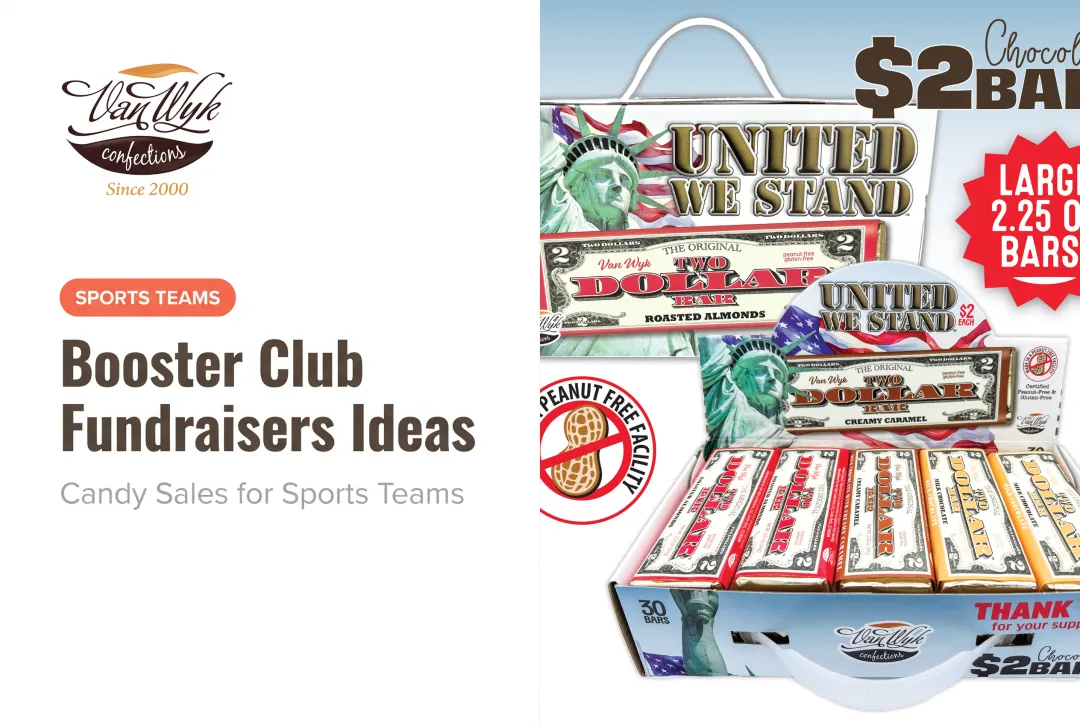
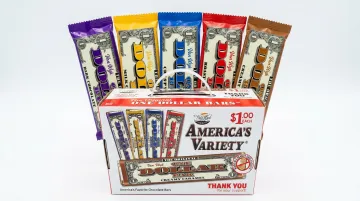
Premium chocolate with strong branding commands repeat buyers and builds community goodwill. Van Wyk Confections' Original ONE DOLLAR BAR and Chocolatiers Premium Chocolate Bars are solid examples of ready-to-sell options designed specifically for fundraising.
The ONE DOLLAR BAR checks several boxes that matter for school programs:
- Produced in a certified peanut-free, gluten-free facility
- Available in a variety pack of five flavors
- 40–50% profit margins with no high minimums to get started
- Backed by over $50 million raised for nonprofits since 2000
Pretzel Rods, Popcorn, and Savory Snack Fundraisers
Savory options alongside sweet ones broaden your audience. Not everyone wants chocolate, but most people will reach for a pretzel rod or a bag of popcorn — especially at game-day events or community gatherings. A mixed product lineup (sweet + salty) consistently produces higher average order sizes.
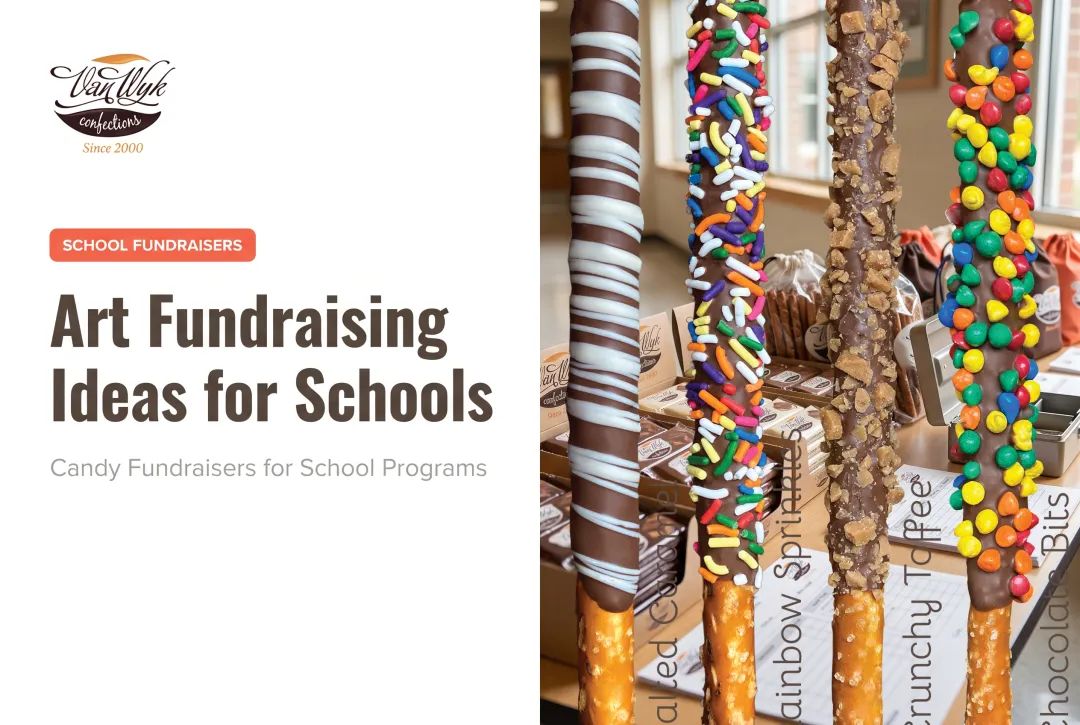
Van Wyk's Sweet & Salty Pretzel RODS are also peanut-free and gluten-free, available in four flavors including Salted Caramel and Crunchy Toffee. Pairing them with chocolate bars gives your team a lineup that covers both preferences in one sale.
Band Spirit Merchandise
Custom apparel serves two purposes: it raises money and builds program visibility. T-shirts, hoodies, and stickers with the band's name or logo turn every buyer into a walking advertisement.
Use a pre-order model to eliminate inventory risk entirely — collect orders and payment first, then produce. Adding personalization (student name, instrument section) is a proven tactic that increases purchase intent.
Seasonal Catalog or Gift Item Fundraisers
Aligning product sales with fall and winter holiday shopping lifts both participation rates and average sale amounts. Catalog programs through established fundraising suppliers also handle shipping and distribution logistics, which reduces the administrative load on booster volunteers.
Community Event and Digital Band Fundraiser Ideas
Community Events That Build Visibility
Car washes, pancake breakfasts, and tag days share a common advantage: students show up in uniform, which is itself a powerful trust signal for community donors. Car washes keep costs minimal with donated supplies. Pancake breakfasts pair naturally with a pep band performance, turning a simple breakfast into an experience. Tag days send students to local shopping areas with donation buckets and a performance schedule.
Pair any in-person community event with a QR code linking to an online donation page — many supporters prefer digital giving and the code ensures you don't miss them.
Restaurant spirit nights require zero upfront cost and minimal volunteer hours. A local restaurant (Chipotle, Panda Express, Panera, and others all run formal programs) donates 15–28% of qualifying sales when customers mention the band. Adding a short student performance during dinner hour reliably increases foot traffic. These work well during off-peak fundraising periods when big campaigns aren't running.
Digital and Online Campaigns
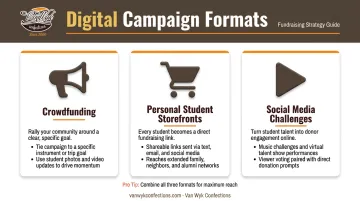
These in-person events build community visibility, but digital options extend your reach well beyond the neighborhood. Three formats consistently deliver for band programs:
- Crowdfunding — tie it to a specific goal ("Help us raise $4,000 for state competition travel") rather than a generic donation ask. Student photos, short video testimonials, and regular progress updates keep momentum going through the campaign window.
- Online product storefronts with personal student links — each student shares their own store via text, email, or social media, reaching grandparents, alumni, and extended family who won't buy from a neighborhood table but order online without hesitation. Especially valuable during competition season when face-to-face selling isn't realistic.
- Social media challenges and virtual talent shows — music-related challenges (performing in an unusual location, a pass-the-beat relay) and video talent shows where viewers vote with donations carry genuine viral potential. Even modest reach drives awareness and dollars.
Each of these digital campaigns pairs naturally with a simultaneous product fundraiser — selling $1 or $2 candy bars at rehearsals and events gives students an easy, face-to-face income stream while the online campaign runs in the background.
How to Run a Band Fundraiser That Actually Works
Choose Fewer, Higher-Impact Fundraisers
Fundraiser fatigue is one of the biggest killers of participation. When families face repeated asks, engagement drops — and the goodwill that makes future fundraisers work erodes. One or two well-chosen fundraisers per semester consistently outperform five low-effort ones, both in immediate revenue and in long-term donor loyalty.
Coordinate Timing Carefully
Check the school-wide fundraising calendar before launching anything. A band product sale launched the same week as the PTA cookie dough drive or the soccer team's snack sale splits the same pool of donor dollars.
Band programs have a natural scheduling advantage here. Fall competition season and spring concert season both create high-energy moments with built-in audiences, so time your fundraisers around them.
Match the Fundraiser to Your Band's Capacity
Event-based fundraisers need volunteers, logistics, and planning time. They're a strong fit for programs with an active booster club. Product fundraisers and online campaigns are lower-lift and a better match for programs with lean support teams. Shelf-stable options like candy bars, pretzel rods, and popcorn also eliminate the headaches of perishable goods and temperature-sensitive logistics.
Set Clear Goals and Track Progress Publicly
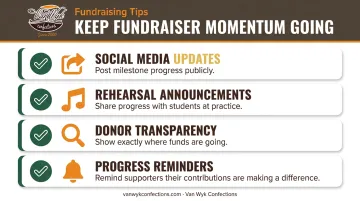
Break your financial goal into per-student or per-family terms. "Each student needs to raise $150" is actionable. "We need $6,000" is abstract. To keep momentum through the full campaign window:
- Post milestone updates on social media and in the school newsletter
- Announce progress at rehearsal so students feel the energy
- Show donors exactly where funds go — that visibility motivates repeat giving
- Use progress updates as a reminder that contributions are making a real difference
Frequently Asked Questions
What are the most profitable band fundraiser ideas?
Product fundraisers with strong per-unit margins — candy bars, pretzel rods, and popcorn at 40–50% profit — tend to generate the highest and most consistent returns. Ticketed performance events add significant revenue when stacked with merchandise sales and concessions, especially during peak school-spirit seasons.
How much money can a school band realistically raise through fundraising?
It varies widely by band size and fundraiser type. A well-run product sale can generate hundreds to several thousand dollars depending on participation. Robinson High School's Rehearse-a-Thon raised over $30,000 with 354 students, showing what's possible when strong participation meets the right format.
When is the best time of year to run a band fundraiser?
Fall (football and competition season) and late winter/spring (ahead of travel or band camp expenses) are the two strongest windows. Timing fundraisers around existing high-attendance events — games, concerts, recitals — gives them a built-in audience and reduces the promotional effort required.
What are easy band fundraiser ideas that don't require a lot of volunteer time?
Online product sales with personal student store links, restaurant spirit nights, and crowdfunding campaigns are the lowest-lift options. They require minimal coordination from directors or booster volunteers and can reach supporters well beyond the immediate school community.
How can band boosters avoid fundraiser fatigue among families?
Limit the number of fundraisers per year, choose high-margin options so fewer campaigns are needed, and make sure each fundraiser offers genuine value — a great product, a fun event — rather than a routine ask for donations. Quality over quantity protects long-term donor relationships.
Can small bands with limited members still fundraise effectively?
Yes. Online campaigns and personal store links reach alumni, extended family, and community members regardless of band size. No-minimum product programs and low-overhead events like restaurant nights or music trivia don't require large volunteer teams — the right fundraiser matters more than headcount.