That reality creates real pressure. Tuition keeps climbing, yet most Catholic schools want to keep education within reach for working families. Something has to bridge that gap, and fundraising is usually it.
This guide walks through proven fundraising ideas for Catholic schools, how to match the right one to your community, and why product-based fundraisers keep showing up as a favorite among school leaders who are short on volunteer hours.
Key Takeaways
- Fundraising's share of school budgets varies widely by diocese and location, alongside tuition and parish support
- The best fundraisers pair strong margins with low volunteer effort and a genuine faith connection
- Candy, snack, and confectionery sales often deliver 40-50% profit margins with minimal event-planning effort
- Early parish and alumni involvement, plus online ordering, outperforms generic donation asks
Why Fundraising Matters for Catholic Schools
Catholic and parochial schools rely on a patchwork of tuition, parish contributions, and fundraising dollars to stay open. There's no uniform national formula for how that pie gets split. It varies by diocese, school size, and local support.
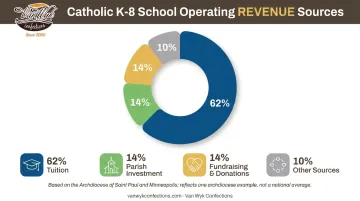
One useful data point comes from the Archdiocese of Saint Paul and Minneapolis, whose 2025 report on K-8 Catholic schools broke down operating revenue as follows:
- 62% from tuition
- 14% from parish investment
- 14% from fundraising and donations
- 10% from other sources
This is a single archdiocese example, not a national average. Still, it reflects a pattern common across many Catholic school communities: tuition alone rarely covers full operating costs. Fundraising and parish support fill the remaining gap, and that gap is often the difference between a balanced budget and a tuition hike.
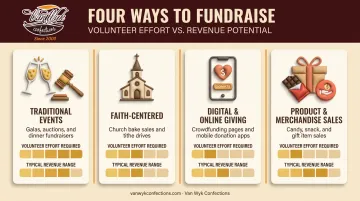
Schools that consistently close that funding gap typically don't lean on one method. They blend traditional events, faith-based traditions, and product sales, three categories we'll break down next.
Top Catholic School Fundraising Ideas
These ideas are grouped by type, so you can pick what fits your community's size, volunteer bandwidth, and timeline.
Traditional Events That Bring the Community Together
Galas, auctions, and walkathons remain reliable revenue generators for Catholic schools. Holy Trinity Catholic School's 2026 gala reported gross receipts of $555,667 and roughly $444,000 net, funding both operating needs and special projects.
On the smaller end, fun runs and walkathons still deliver meaningful results. Northside Catholic Academy's Wildcat Fun Run raised $40,000 for a cafeteria renovation, while St. Gabriel School's walkathon brought in $80,000 for furniture and safety upgrades.
The tradeoff: these events require months of planning, volunteer coordination, and often a rental venue or catering budget.
Raffles and 50/50 drawings offer a lower-effort alternative with strong turnout. Catholic United Financial's Catholic Schools Raffle has raised more than $16 million since 2009, with its 2026 campaign alone bringing in $959,266 across 50 participating schools, an average of $12,000 per school. Schools keep proceeds from each ticket sold, making raffles one of the more predictable options on this list.
Silent auctions and golf tournaments round out this category. Both tend to attract business sponsors and higher-value donors. One diocesan golf tournament, the Bishop George Rueger Memorial, raised $52,000 for student scholarships in a single year.
Faith-Centered & Parish-Partnered Fundraisers
Fish fries during Lent are a Catholic tradition with deep roots. The practice became especially widespread after 1966, when year-round Friday meat abstinence became optional outside Lent, according to the Associated Press.
Many parishes and schools still use them to offset budget pressure, though not every fish fry is run as a fundraiser. Some churches treat them purely as community outreach.
Other faith-centered options include:
- Donation drives for school supplies, often timed around the start of the academic year
- Parish collections during Advent or Lent that directly benefit school operations
- Partnerships with the Knights of Columbus, whose Bright Futures program formally encourages local councils to run tuition fundraisers, supply drives, and school maintenance projects
These partnerships work because they tap into networks that already trust the school's mission. That trust translates into donations more easily than a cold outreach ever could.
Modern & Digital Fundraising Approaches
Online giving has become a genuine force in Catholic fundraising. #iGiveCatholic, a national giving-day campaign, generated $26,728,564 from 64,180 donors supporting 1,845 Catholic organizations in 2025. That figure spans parishes, ministries, and schools together, not schools alone, but it demonstrates real appetite for digital Catholic giving.
Crowdfunding platforms work best for specific, tangible goals: a new science lab, updated technology, or building repairs. Donors respond to concrete asks more than vague appeals.
Other digital tactics worth considering:
- Grant applications through Catholic foundations, a supplemental funding stream separate from event-based fundraising
- Peer-to-peer fundraising, where parents and alumni share campaign links through their own social networks
- Simple online donation pages, which remove friction for supporters who'd rather give in thirty seconds than write a check
Product & Merchandise Sales Fundraisers
Product sales, think candy bars, cookie dough, popcorn, and fortune cookies, consistently rank among the easiest fundraisers to run. There's no venue to book, no volunteers needed for setup, and no event insurance to secure. Students and parents simply take orders.
This format works across every age group, from kindergarten classrooms to high school clubs, and pairs naturally with other events. A bake sale alongside an auction, or a candy table at a fish fry, adds revenue without adding meaningfully to the workload.
Product margins vary widely depending on the supplier, so it pays to know what separates a high-profit program from one that eats into your proceeds.
Why Confectionery & Snack Fundraisers Are a Top Pick for Catholic Schools
Product fundraisers succeed for a simple reason: students and parents sell to people they already know. Family, parish members, neighbors. No event venue. No elaborate planning committee. Just an order form and a network of people who want to support the school.
Confectionery fundraisers commonly deliver 40-50% profit margins, a figure that tends to hold up better than many event-based fundraisers once you subtract venue rental, catering, staffing, and other overhead. A gala might gross impressive numbers, but the net figure after expenses often tells a different story.
A Family-Owned Fundraising Partner
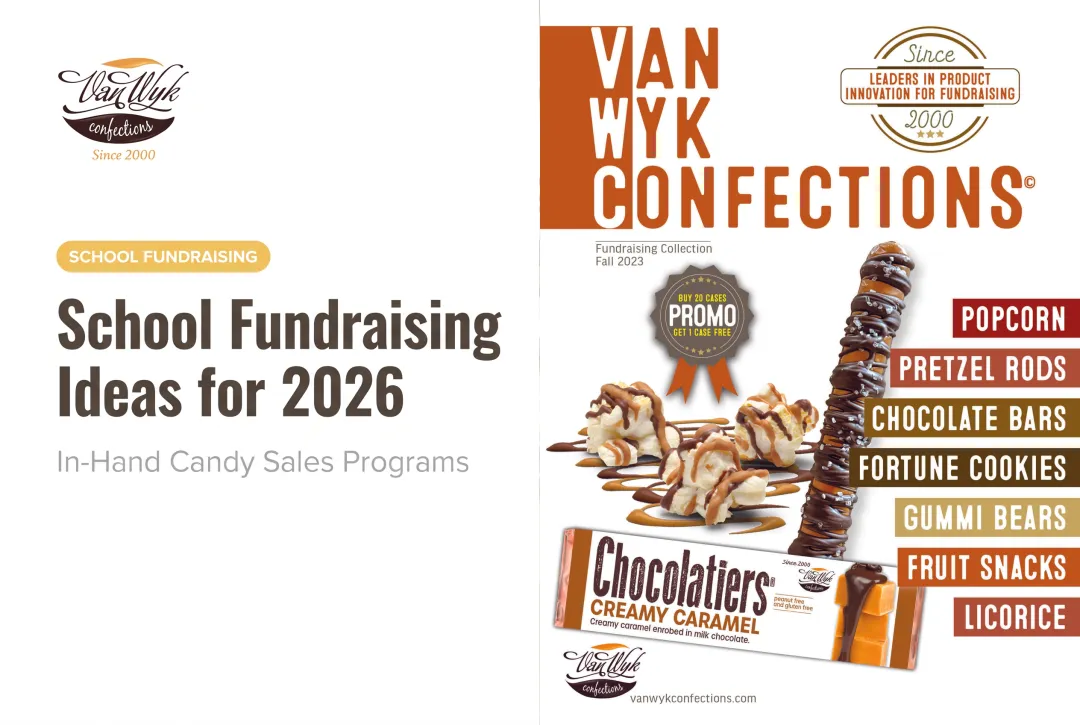
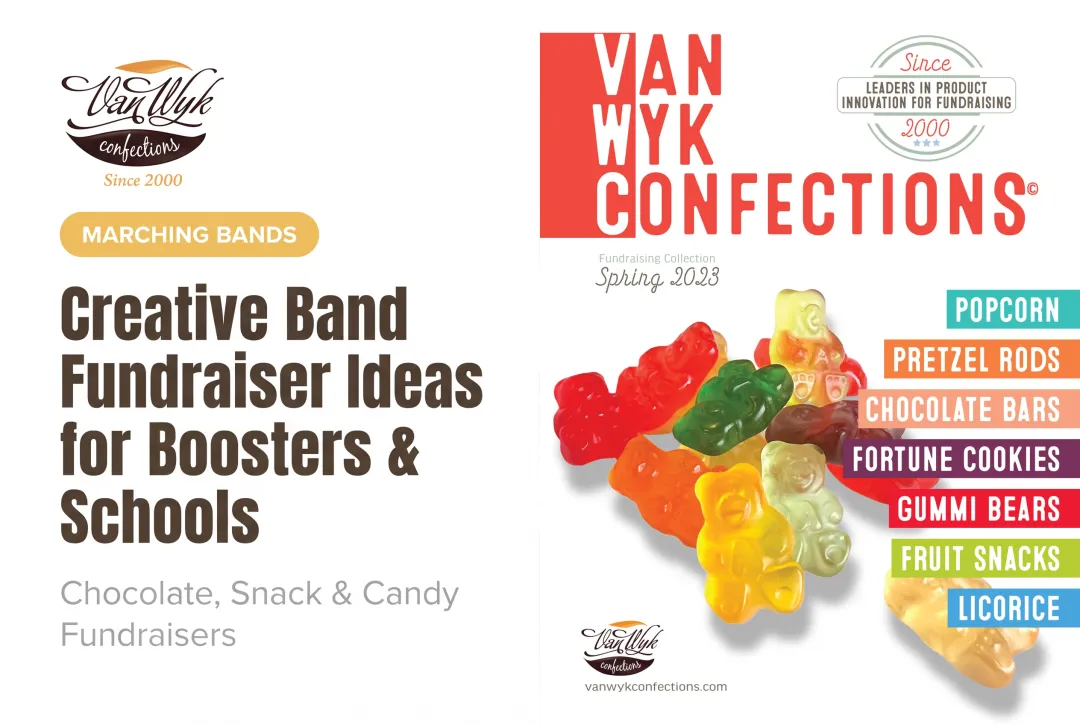
Van Wyk Confections has worked with schools, churches, and clubs nationwide since 2000, helping groups run candy and snack fundraising programs that don't require an event calendar. Founded by Mark Van Wyk with the Original ONE DOLLAR BAR, the company has since helped nonprofit groups collectively raise over $50 million through their programs.
For Catholic schools weighing a product partner, a few practical details matter:
- Low order minimums, so smaller parish schools aren't stuck with excess inventory
- Fast nationwide shipping, important when a fundraiser has a tight deadline
- Factory-sealed freshness, since nobody wants melted chocolate showing up mid-campaign
- Allergen-conscious options, including peanut-free products for schools balancing dietary needs across their student body
Product Line Comparison
| Product Line | Best-Fit Use Case | Profit Margin Range | Order Flexibility |
|---|---|---|---|
| ONE DOLLAR BAR | Grab-and-go sales, all-ages campaigns | 40-50% | Case-based ordering, peanut-free option available |
| Chocolatiers Premium Chocolate Bars | Holiday and seasonal sales | 40-50% | Case-based ordering, no long lead times |
| Pretzel Rods/Twists | Concession add-on, sports events | 40-50% | Full case of 240 units, smaller box and peanut-free options available |
| Gourmet Popcorn | Fall and winter seasonal sales | 40-50% | Case-based ordering, no long lead times |
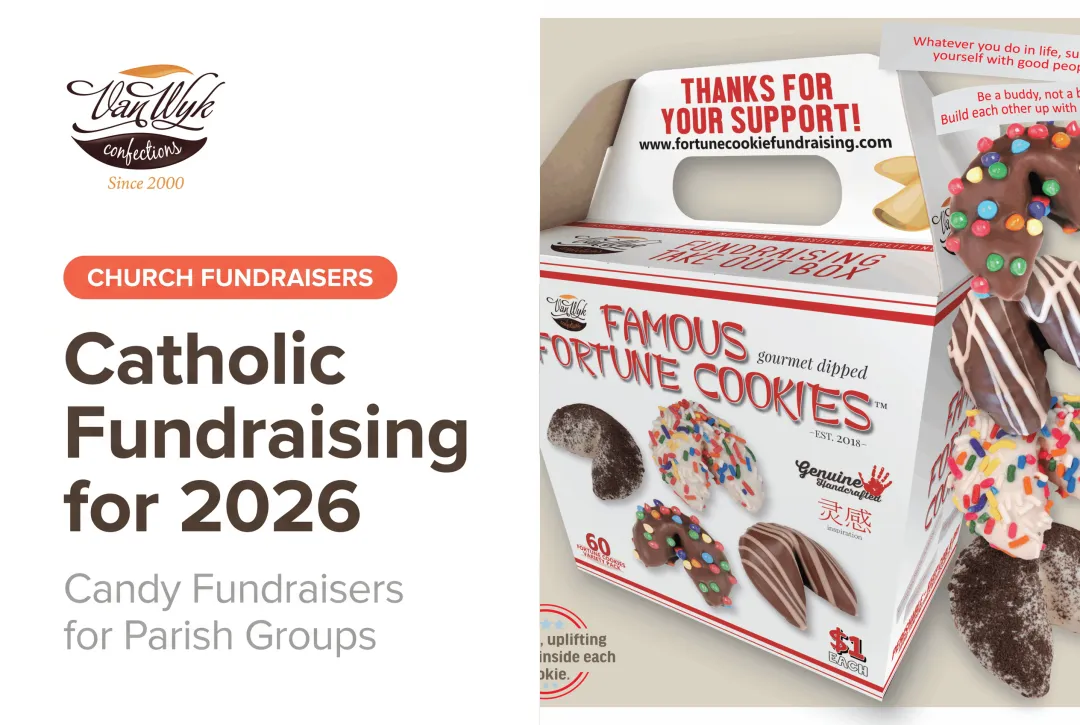
| Famous Fortune Cookies | Novelty sales, school events | 40-50% | Case-based ordering, no long lead times |
Pairing a product sale with an event you're already running (chocolate bars at the fish fry table, popcorn during the walkathon) adds revenue without adding a single extra volunteer shift.
How to Choose & Plan the Right Fundraiser for Your School
Start with a specific dollar goal tied to a specific need. "Help us raise $10,000 for classroom Chromebooks" lands better than a generic appeal, because donors know exactly where their money goes.
Next, be honest about volunteer capacity. A school with three active parent volunteers shouldn't default to planning an elaborate annual gala just because that's what everyone else does. Match the fundraiser's complexity to what your community can realistically pull off this year.
A few planning essentials:
- Set a clear, specific goal — tuition assistance, a facility repair, new technology
- Match effort to capacity — product fundraisers like chocolate bar or pretzel rod sales need far less coordination than a gala, so they work well with a thin volunteer pool
- Offer simple online ordering or donation options — friction kills participation
- Involve parish leadership and alumni early — personal, faith-connected appeals consistently outperform generic requests
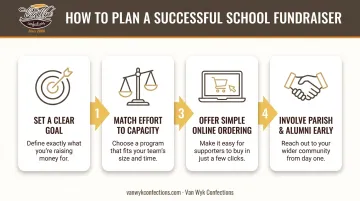
Schools that skip step four often leave money on the table. A pastor's endorsement, or a personal letter from a student, tends to move people in a way a mass email never will.
Conclusion
Successful Catholic school fundraising rarely comes down to one method. It's community events and faith-centered traditions, layered with steady product sales that carry the campaign through the year.
Track what actually works for your school each year, not what worked for the school down the road. If your volunteer bandwidth is thin, shift more weight toward higher-margin, lower-effort options like confectionery sales instead of another gala.
If you're building out next year's fundraising calendar, Van Wyk Confections' fundraising programs are worth a look. They offer a low-lift way to add reliable profit to your campaign without asking your volunteers for more than they can give.
Frequently Asked Questions
What is the most profitable fundraiser for schools?
There's no single universal answer, since results vary by school size and community. Auctions, fun runs, and product-based fundraisers like candy sales all show strong results when matched to the right community and executed well.
What is the easiest fundraiser to run for a Catholic school?
Product sales such as candy bars, popcorn, and cookie dough are among the easiest. No venue, no elaborate setup, and students simply take orders from people they know.
What are good Lent or faith-based fundraising ideas for Catholic schools?
Fish fries on Lenten Fridays remain a Catholic tradition, alongside Advent and Lent parish collections and donation drives tied to the school's mission. Not every fish fry is run as a fundraiser, so confirm the goal upfront.
How much profit margin should a school expect from a product-based fundraiser?
Confectionery and snack fundraising programs commonly offer 40-50% profit margins. That's often higher than event-based fundraisers once venue, staffing, and catering costs are subtracted.
Are crowdfunding and online campaigns effective for Catholic schools?
Yes, especially when paired with a specific, compelling story about the funding need. Campaigns like #iGiveCatholic show strong digital giving appetite across Catholic organizations nationwide.
How can Catholic schools get parish and alumni support for fundraising?
Involve the pastor directly in appeals, host joint parish-school events, and use personalized outreach like handwritten letters or student-designed cards for alumni and parishioners.