Introduction
Every parish council and school finance committee knows the feeling: budgets are tighter, and 2026 isn't bringing relief. Rising insurance premiums, staff salary adjustments, and aging facilities are adding up faster than tuition checks can cover.
Tuition typically covers 70%-80% of Catholic school operating costs, while fundraising contributes an estimated 4%-10% of school income, according to a Spring 2025 NCEA Momentum analysis. That gap doesn't close itself.
This guide breaks down the top Catholic fundraising ideas for 2026 and a practical planning framework to put them into action. It also covers how to choose a fundraising partner, including product-based options, without adding stress to your volunteer committee.
Key Takeaways
- Catholic schools and parishes need fundraising to close real 2026 budget gaps, not just add extras.
- Winning 2026 campaigns pair faith traditions such as Advent and Lent with digital tools like recurring giving.
- Product-based fundraisers offer low risk and strong margins with minimal upfront investment.
- Catholic Schools Week, Lent, Advent, and GivingTuesday all offer built-in engagement windows.
- A supplier with low minimums, fast shipping, and full support simplifies logistics for volunteers.
Why Catholic Fundraising Matters More Than Ever in 2026
The Budget Math Doesn't Add Up on Tuition Alone
Tuition alone rarely covers the full cost of running a Catholic school. Even with tuition supplying 70%-80% of operating costs and fundraising adding 4%-10% more, that still leaves a meaningful shortfall most schools fill through parish subsidies, endowments, or belt-tightening. For parishes without a school, offertory and fundraising events often carry an even heavier share of the load.
Costs Are Climbing Faster Than Collections
Diocesan budget memos for 2025-26 paint a clear picture. The Diocese of Sacramento's FY2025-26 assumptions include a 3.5% lay salary increase, health premium hikes of 13%-20%, and a 19% jump in property insurance. The Archdiocese of Washington's FY2026-27 guidance projects a 15% lay-healthcare increase plus new per-student technology and accreditation fees.
These numbers come from real dioceses, not nationwide averages, and they point to a consistent trend: fixed costs are rising faster than tuition or offertory income can absorb without help.
Your Donor Base Is Shifting
Rising costs are only half the equation. Weekly Mass attendance nationally has climbed back to roughly 24%, close to pre-pandemic levels, according to CARA-derived data reported by EWTN. That's encouraging news. Still, some dioceses, like Seattle, have reported declining registered households even as local population grows.
That mismatch matters. Schools and parishes can no longer rely solely on a shrinking pool of registered core families. Fundraising in 2026 needs to reach:
- Alumni who no longer attend weekly Mass
- Extended family and grandparents
- Local businesses and community sponsors
- Broader parish networks beyond the pledge card list
Top Catholic Fundraising Ideas for 2026
Faith-Based & Community Events
Fundraisers that connect directly to Catholic values tend to outperform generic asks. They tie giving to stewardship, not just a transaction.
Strong options for 2026 include:
- Chapel or ministry sponsorships where donors fund a specific need (a statue restoration, youth ministry supplies, or a scholarship fund)
- Advent and Lent donation drives built around almsgiving traditions already familiar to parishioners
- Parish-school partnership events, like a joint fall festival or spring gala, that pool volunteer effort
- Volunteer talent auctions, where parishioners bid on skills like home repair, tutoring, or catering to fund parish projects
Large-scale events still work when timed well. Galas, silent auctions, and walkathons consistently draw strong turnout. Anchor your biggest push around National Catholic Schools Week, January 25-31, 2026, a natural moment for community visibility and giving.
Product-Based Fundraisers
Product sales remain a staple for a reason: no long lead times, low upfront cost, and kids can sell them without needing a sales pitch. For CCD programs and youth groups especially, this simplicity matters.
Why they still work in 2026:
- Low financial risk for volunteer-run committees
- Family-led selling requires little training
- Products ship and sell fast, no waiting on custom manufacturing
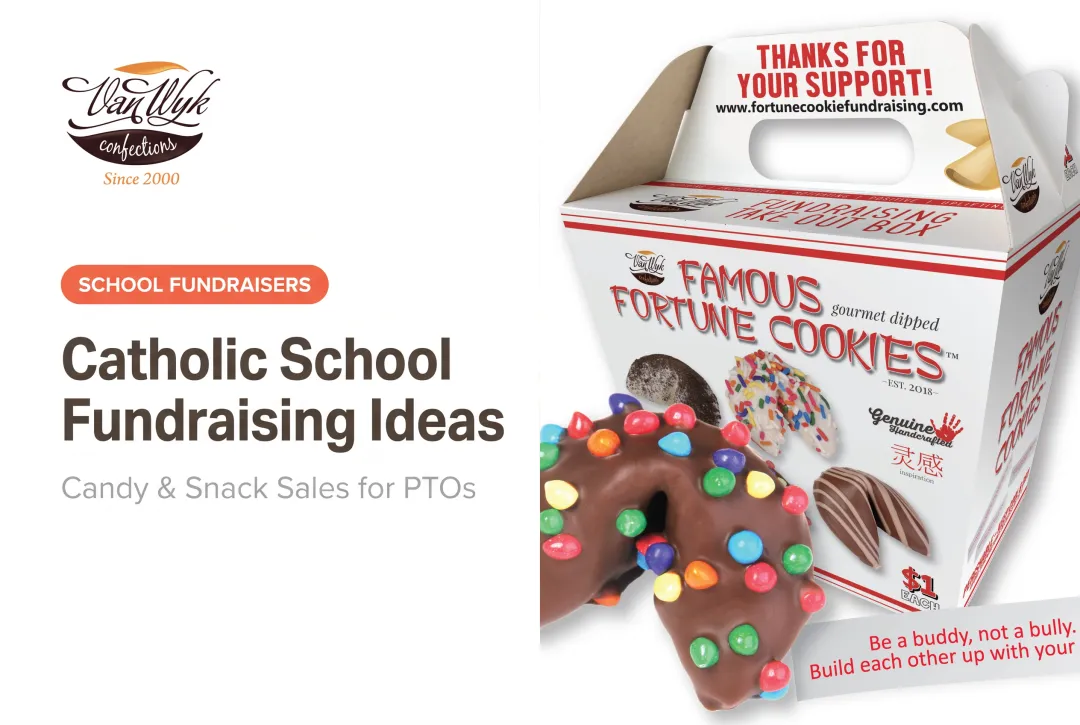
Van Wyk Confections, a family-run supplier in the fundraising business since 2000, offers a useful example of what to look for.
Their One Dollar Bars are peanut-free and gluten-free, made in a dedicated peanut-free facility. Paired with the Nifty 50 Chocolatiers Pack, both ship with a 1-case minimum order and fast nationwide delivery, letting groups launch quickly without overcommitting inventory.
Pair product sales with faith-themed timing for extra relevance:
- Lenten fish-fry season and pretzel sales (pretzels have Lenten roots themselves)
- Sacrament season treats covering First Communion, Confirmation, and Advent countdown sales into Christmas
Modern & Digital Campaigns
Digital tools extend your reach well past the people who show up on Sunday.
- Crowdfunding and peer-to-peer campaigns let families create their own giving pages and share them with extended networks
- GivingTuesday, December 1, 2026, is a strong anchor date for a year-end digital push
- Recurring/monthly giving now accounts for 31% of online nonprofit revenue, according to M+R's 2025 Benchmarks report
For larger capital needs, like a chapel renovation or major facility repair, look into FADICA's Catholic Funding Guide, a searchable database connecting Catholic institutions with funders. It's a prospecting tool, not an open grant application, so confirm eligibility directly with each funder listed.
How to Plan a Successful Catholic Fundraiser: Step-by-Step for 2026
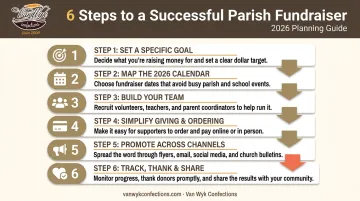
Solid fundraisers rarely happen by accident. Follow this sequence:
- Set a specific goal. Tie the ask to a defined need, such as tuition assistance, a chapel repair, or a mission trip, rather than a vague "support our school" message.
- Map your 2026 calendar early. Build campaigns around Catholic Schools Week (Jan 25-31), Lent (Ash Wednesday, Feb 18), Advent (starting Nov 29), and GivingTuesday (Dec 1).
- Build your team. Assign roles across staff, parish council, PTA, and volunteers. Get diocese or pastor sign-off before launch; most dioceses require written approval for product-marketing fundraisers.
- Simplify giving and ordering. Offer online payment tools, mobile giving, and simple paper order forms side by side; don't force everyone into one channel.
- Promote across multiple channels. Church bulletins, school newsletters, social media, and personal invitations all matter, especially when messaging ties back to mission.
- Track, thank, and share. Measure results against your original goal, send thank-yous quickly, and publish a short impact update to build momentum for the next campaign.
Choosing the Right Fundraising Partner: What to Look for in a Product Supplier
Not all fundraising suppliers are built the same, and the wrong choice creates extra work for volunteers who already have full plates.
Order Minimums, Delivery, and Product Quality
Small CCD classes or parish groups shouldn't be stuck with excess inventory. A 1-case minimum keeps risk low for first-time or smaller campaigns. Just as important: reliable nationwide shipping that won't leave you scrambling before Lent or the holiday season.
Quality matters just as much as logistics. Look for suppliers offering:
- Freshness guarantees on sealed, individually wrapped products
- Peanut-free and gluten-free options for diverse school and parish communities
- A product lineup that doesn't require special storage or refrigeration
Full-Service Support
A good partner does more than ship boxes. Van Wyk Confections built its model around this idea, offering training materials, marketing flyers, and dedicated account support for schools, churches, and nonprofits. In more than 26 years, the company has helped groups nationwide raise over $50 million for their causes.
Comparing Profit Margins
Most product fundraising companies advertise margins somewhere in the 40%-50% range, though the Association of Fundraising Distributors and Suppliers notes these percentages vary widely by product and service level. Don't just compare percentages. Ask what real dollar amount a group your size can expect to net after shipping and any hidden fees.
Tips to Maximize Profit, Participation, and Donor Retention
A single successful event is good. A sustainable giving culture is better.
- Add recurring giving enrollment. Monthly donors generate 2.75 times the annual value of one-time gifts, per GivingTuesday's Data Commons. A simple sign-up card at Mass can start this habit.
- Mobilize alumni and parishioner networks. Peer-to-peer sharing, where families text or post their own giving link, tends to convert better than a single mass email.
- Apply the 80/20 principle loosely. Give top donors extra stewardship attention while keeping small-dollar options, like product sales, open to everyone else. Treat this as a flexible planning guide rather than a strict statistic.
Frequently Asked Questions
How do you raise money for a Catholic school?
Combine faith-based events (galas, Advent/Lent drives), product-based fundraisers like candy or snack sales, and digital campaigns such as crowdfunding or GivingTuesday pushes. Follow the six-step planning framework above to align timing and team roles.
What is the most profitable fundraiser for a Catholic school or parish in 2026?
Auctions and product-based fundraisers with strong margins (often 40%-50%) tend to perform best, though results depend heavily on community size and the effort volunteers put in.
What's the best time of year to run a Catholic school fundraiser?
Catholic Schools Week (January 25-31, 2026), Lent, Advent, and GivingTuesday (December 1, 2026) are all strategically strong windows tied to natural community engagement.
Are candy bar and product fundraisers profitable for churches and schools?
Yes. Product fundraisers typically offer solid profit margins with minimal upfront investment, making them accessible even for smaller, volunteer-run groups.
How much of a Catholic school's budget typically comes from fundraising?
Fundraising is estimated to supply 4%-10% of school income, while tuition covers 70%-80% of operating costs. The remaining gap often relies on parish or diocesan support, which varies significantly by location.
What makes a fundraising idea "faith-based" versus a general fundraiser?
Faith-based fundraisers intentionally connect the ask to Catholic values, liturgical seasons, or ministry needs, like an Advent giving drive, rather than treating giving as a purely transactional exchange.