Introduction
School fundraising isn't optional anymore. It's how PTAs cover field trips, classroom technology, and basic supplies that shrinking budgets no longer cover.
More than 75% of school and district leaders expect federal education funding to keep declining, according to a June 2025 survey reported by Education Week. Two-thirds plan to respond with staff cuts, and over half expect to trim academic programs like tutoring.
That funding gap has pushed schools toward two very different paths: selling physical products like candy and snacks, or running donation-based platforms and event campaigns. Pick the wrong fit for your group's size and volunteer bandwidth, and you leave real money on the table.
This guide compares the top fundraising companies for schools in 2026 across both models, so PTAs, booster clubs, and teachers can choose with confidence instead of guesswork.
TL;DR
- Six companies compared: Van Wyk Confections, ABC Fundraising, RallyUp, Snap! Raise, Get Movin' Fundraising, and DonorsChoose
- Product fundraisers net 40-50% profit; no-product platforms can hit 90%+ with stronger direct asks
- Key selection criteria: profit margin, setup ease, delivery reliability, support, and group-size fit
- The right choice depends on whether your school wants a product sale or a pure donation drive
Overview of Fundraising Companies for Schools in 2026
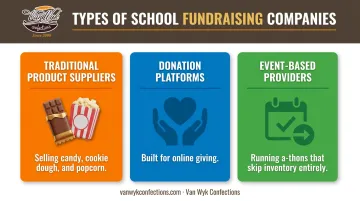
A "school fundraising company" in 2026 covers far more ground than it did a decade ago. The category now includes:
- Traditional product suppliers selling candy, cookie dough, and popcorn
- Donation platforms built for online giving
- Event-based a-thon providers that skip inventory entirely
Budget pressure explains the growth. With the funding declines schools are already bracing for, parent groups and booster clubs are covering gaps that federal dollars used to fill.
That's why comparing companies side by side matters. The list below evaluates both product-based and platform-based options using the same criteria, so your school can compare apples to apples before committing a full semester's calendar to one program.
Top Fundraising Companies for Schools in 2026
Each company below was evaluated on profit margin, product or program quality, ease of running the campaign, nationwide reach, and verified reputation, including reviews, years in business, and association memberships like AFRDS (Association for Fundraising Distributors and Suppliers).
Van Wyk Confections
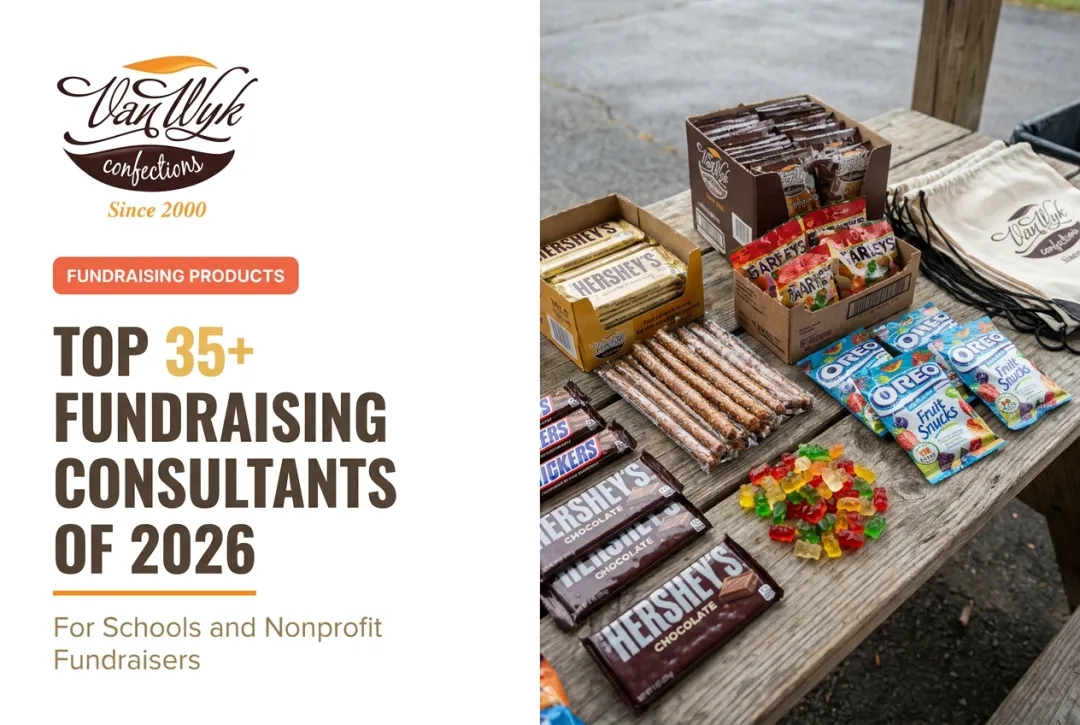
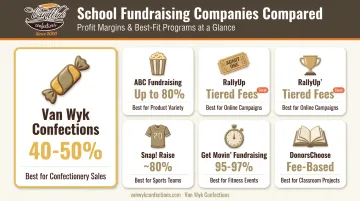
Van Wyk Confections is a family-owned confectionery fundraising supplier founded in 2000 in Castle Rock, Colorado. It's an AFRDS member with over 26 years in the candy industry, and it has helped nonprofit groups and schools raise more than $50 million nationwide.
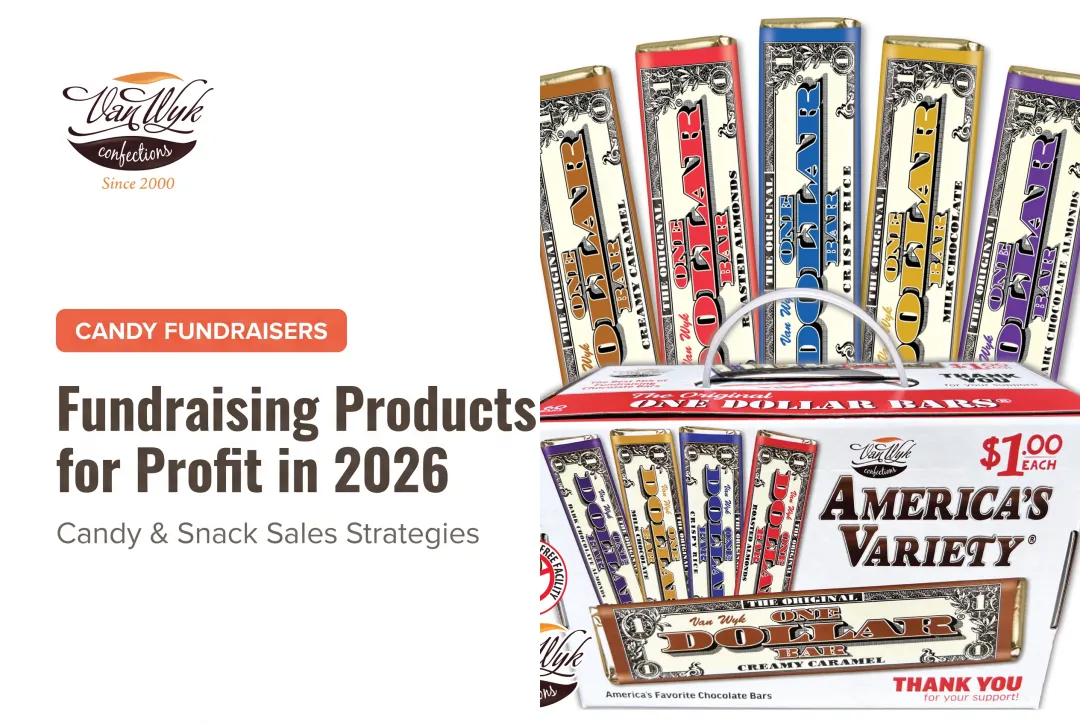
The company created the original ONE DOLLAR BAR and the Sweet & Salty Pretzel RODS, both still core to its lineup. Orders ship from more than 10 warehouses across the country, and every case arrives factory-sealed for freshness. Peanut-free and gluten-free chocolate bar options are available, with just a 1-case minimum and no complicated tiered ordering.
| Best For | Schools and PTAs wanting a proven, high-margin candy and snack fundraiser with minimal setup |
| Profit Model | 40-50% profit on product sales, no high minimums or long lead times |
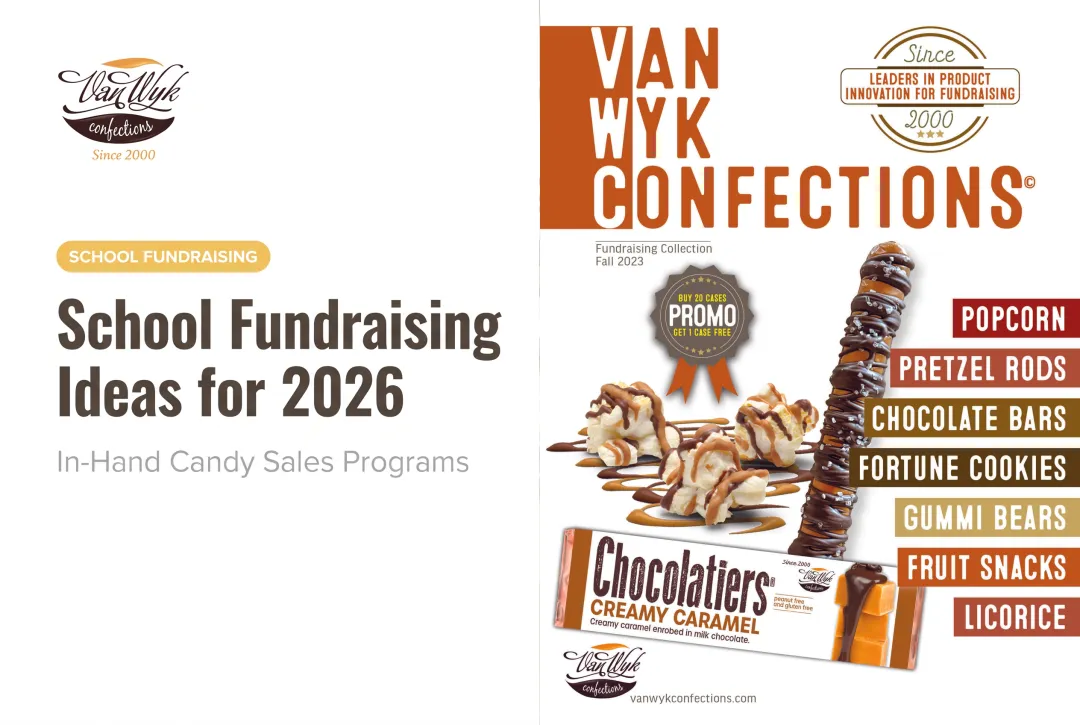
| Product Lineup | Chocolate bars, pretzel rods and twists, gourmet popcorn, and Famous Fortune Cookies |
ABC Fundraising
ABC Fundraising is a long-running product fundraising partner with a broad catalog spanning popcorn, cookie dough, candy, discount cards, and custom apparel, sold through online storefronts built for individual sellers.
The product variety and app-based selling cut down on the marketing work schools would otherwise handle themselves. Profit isn't one flat number here; it varies by program, with popcorn and snack programs advertised up to 70%, Hi-Chew candy up to 75%, and cookie dough up to 80%.
| Best For | Schools wanting variety across multiple product categories in one program |
| Delivery | Orders typically ship about three weeks after the campaign closes |
| Profit Model | Varies by program: popcorn up to 70%, candy up to 75%, cookie dough up to 80% |
RallyUp
RallyUp bundles raffles, auctions, ticketing, crowdfunding, and storefront sales into one platform used by schools, PTAs, and nonprofits running events.
Schools can mix formats, such as a raffle, spirit wear, and ticketing, instead of juggling separate tools. The Free plan carries no platform fee, funded instead by optional donor tips. According to RallyUp's pricing page, the paid Flex plan charges tiered fees ranging from 2.9% for ticketing and storefront sales up to 6.9% for raffles, plus separate payment processing costs.
| Best For | Schools running galas, raffles, or hybrid in-person/online events |
| Pricing | Free plan (0% platform fee, optional donor tip) or Flex plan with tiered fees by fundraiser type |
| Key Feature | Peer-to-peer selling pages with classroom or team leaderboards |
Snap! Raise
Snap! Raise is a team-based fundraising platform built for athletics, band, and school clubs, walking coaches and team captains through a structured campaign from setup to payout.
Hands-on campaign coaching targets team-specific goals, like travel costs or new equipment, rather than whole-school drives. Snap! Raise tailors pricing per program rather than publishing one flat rate, deducting fees from funds raised after the campaign closes; partner organizations typically keep around 80%.
| Best For | Athletic teams, band, and club-specific fundraising drives |
| Pricing | Contract-based and tailored per program; teams typically keep around 80% of funds raised |
| Key Feature | Guided campaign setup designed to reduce coordinator workload |
Get Movin' Fundraising
Get Movin' Fundraising is a no-product, event-based platform built around walk-a-thons, jog-a-thons, and similar whole-school events, paired with an online donation hub called FundHub.
Without physical inventory to store, sell, or ship, schools keep a much larger share of what they raise. Get Movin' reports an average 95-97% profit for participating schools, plus 100% of cash and checks collected in person.
| Best For | Schools wanting a no-inventory, whole-school participation event |
| Profit Model | Average 95-97% profit reported; schools keep 100% of in-school cash and checks |
| Key Feature | Free dedicated personal event coach plus a promotional resource toolbox |
DonorsChoose
DonorsChoose is a nonprofit platform where individual public school teachers post specific classroom project requests, from books to STEM kits, that donors fund directly.
Money never touches a general school fund. DonorsChoose purchases and ships the requested materials directly, building in accountability that whole-school fundraisers can't always offer. An optional 15% support allocation and a 1.5% payment processing fee apply on top of the project total, though donors can adjust or opt out of the support fee.
| Best For | Teachers seeking funding for a specific classroom need, like books or STEM kits |
| Pricing | Optional 15% support fee plus a 1.5% processing fee on the project total |
| Key Feature | Direct purchase-and-ship model instead of cash disbursement |
Product-Based vs. Platform-Based Fundraising: Which Is Right for Your School?
Every fundraising decision comes down to one trade-off: a tangible product families want to buy, or a higher margin with no inventory to manage.
The Core Trade-Off
Product fundraisers—think candy, snacks, or popcorn sales—hand families something they'd likely buy anyway. Schools typically net 40-50% after covering supplier costs, though returns swing wider depending on shipping method and campaign size.
Real numbers show why margin isn't the whole story. At Villacorta Elementary, a popcorn fundraiser brought in roughly $11,500 in sales, but about 60% went to the fundraising company, leaving the school around $5,000, according to NPR's reporting on school fundraisers. That's a reminder to check the actual payout, not just the advertised percentage.
No-product platforms flip the model. Because there's no inventory to ship or store, schools can net 90% or more of funds raised. The catch: these campaigns lean almost entirely on direct donor asks, meaning families need a compelling reason to give without a product in hand.
Comparing the Two Models
| Factor | Product-Based | Platform-Based |
|---|---|---|
| Profit margin | 40-50% typical | 90-97%+ typical |
| Logistics effort | Order collection, delivery, distribution | Minimal; mostly digital promotion |
| Upfront cost | Usually none; embedded in wholesale price | Usually none; platform fees deducted from proceeds |
| Best-fit group size | Any size, scales with case orders | Larger community networks with strong digital reach |
Running Both in the Same Year
Many schools no longer pick just one model. A product sale in fall, say a Van Wyk candy or popcorn campaign, pairs well with a spring donation-based a-thon. Spreading revenue across two different asks avoids the donor fatigue that comes from repeating the same campaign twice a year.
The right choice also depends on volunteer bandwidth. Product sales need someone coordinating orders and pickup days. Platforms need someone posting regularly and reminding families to share their page. Match the model to who's actually available to run it, not just which one promises the bigger number.
How We Chose the Best Fundraising Companies for Schools
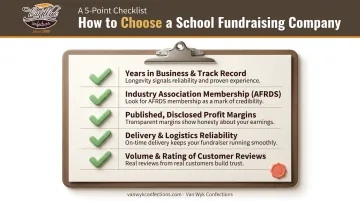
We built this list by checking details that actually affect a school's bottom line, not just marketing copy. Our evaluation looked at:
- Years in business and track record with schools nationwide
- Industry association memberships, particularly AFRDS, which enforces ethical standards for dispute resolution and program accuracy
- Published profit margins and how clearly they're disclosed
- Delivery and logistics reliability, including realistic shipping windows
- Volume and rating of customer reviews
These criteria matter because the biggest mistake schools make is picking a company based on the flashiest catalog or the highest advertised percentage.
Before signing on: confirm real delivery times, minimum order sizes, and any hidden platform or processing fees. A 90% profit claim means little if the fine print requires a minimum most parent groups can't hit.
Conclusion
The best fundraising company for your school is the one whose product, program, and support model fit how much time and volunteer power your group has this year. Name recognition and flashy profit percentages matter less than that fit.
Before signing on with any company for the full year:
- Request a sample kit or info packet
- Ask directly about minimum order requirements
- Confirm delivery windows in writing
Those three steps catch most of the surprises that turn a promising fundraiser into a logistics headache.
With those basics covered, if your school is weighing a straightforward product sale with strong profit margins for its next campaign, Van Wyk Confections offers a free info kit built around its candy and snack programs. The programs run on a 40-50% profit structure and are easy enough for a first-time PTA coordinator to manage without a steep learning curve.
Reach out through their fundraising inquiry form to see samples and current pricing before your next campaign.
Frequently Asked Questions
What is the best fundraising platform for schools?
It depends on the campaign type. All-in-one platforms like RallyUp suit events and raffles, while product suppliers like Van Wyk Confections suit straightforward, high-margin sales fundraisers.
What is the most profitable fundraiser for schools?
No-product a-thons can net the highest percentage of funds raised, sometimes 90% or more. Quality product fundraisers with 40-50% margins remain a reliable, tangible option families enjoy.
How much should a school fundraising company charge?
Product companies typically build costs into the wholesale price, so schools net 40-50% directly. Platforms charge separate platform and processing fees, which should be disclosed upfront.
Are product-based fundraisers still worth it in 2026?
Yes, especially for schools wanting predictable margins, minimal tech setup, and a familiar selling experience families already trust.
What's the difference between a fundraising company and a fundraising platform?
A fundraising company, like a candy or snack supplier, provides physical products to sell. A platform provides software and tools for online donations, events, or peer-to-peer campaigns.
How do I choose the right fundraising company for my school?
Compare profit margin, minimum order size, delivery timelines, and customer reviews. Request a sample kit before committing your school to a full campaign.